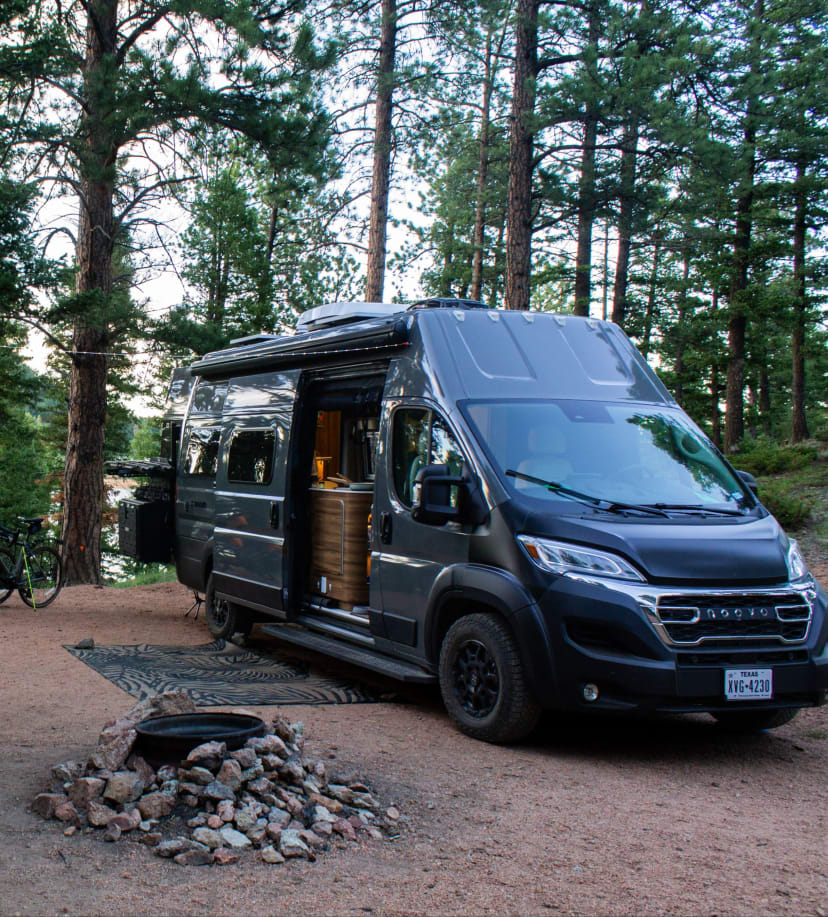
Boondocking in a van is the simplest version of camping there is: park somewhere beautiful, no hookups, no fees, no neighbors. It is also more common than most first-timers expect. Three out of five campers camped for free last year, and nearly 80% of them did it on dispersed public land, according to The Dyrt's 2026 Camping Report.
Here is the short version. You are allowed to stay on most Bureau of Land Management and National Forest land for about two weeks at a time, you carry everything you need, and you leave the spot exactly as you found it. The nuance is the part no one tells you: what actually runs out first, how long a Class B can honestly stay out, and which van systems matter more than others.
Boondocking is camping in a fully self-contained vehicle with no external water, electricity, or sewer connection, almost always outside developed campgrounds and almost always free. In a van, that means your own tanks, your own batteries, and your own bathroom carry the whole stay.
Boondocking, defined. Dry camping on undeveloped public land where you rely entirely on what your van carries. No hookups, no restrooms, no trash service, no fee. The reward is solitude; the price is self-sufficiency.
Four terms people use interchangeably, and how they differ:
| Term | Where it happens | Hookups | Cost | Typical legality |
|---|---|---|---|---|
| Boondocking | Undeveloped public land (BLM, National Forest) | None | Free | Legal where dispersed camping is allowed |
| Dispersed camping | Same land, any vehicle or a tent | None | Free | Legal, with stay limits |
| Dry camping | An established campground or lot without hookups | None | Free to a modest fee | Legal, by permission |
| Stealth camping | City streets and residential areas | None | Free | Often restricted by local ordinance |
The word has a history. "Boondocks" comes from the Tagalog word bundok, meaning mountain, picked up by American soldiers in the Philippines a century ago to describe the middle of nowhere. The verb followed once RVers started camping there on purpose.
The terms overlap. All boondocking is dispersed camping, but dispersed camping also includes tents. Dry camping can happen in a paid campground with the hookups switched off. The distinctions matter mostly for the rules, which is where most beginners get nervous and where the next section helps.
The best legal boondocking in the country sits on federal land in the West, and the two agencies that matter most are the Bureau of Land Management and the U.S. Forest Service. Between them they manage roughly 440 million acres, most of it open to dispersed camping unless a sign says otherwise.
The 14-day rule. On BLM land, dispersed camping is generally limited to 14 days within any 28-day period. After that you move at least 25 to 30 miles and stay away for the rest of the cycle. Most areas require no permit or reservation, vehicles must stay on designated roads, and dispersed camping is for recreation, not long-term living. Local field offices can set tighter limits, so a quick call before a long stay is worth it.
Roads decide more than rules. The legal spot you want is often two miles down a graded dirt road, and the quiet one is four miles down a rutted one. Ground clearance and traction decide which you reach. The all-wheel-drive vans open up the second category, while a front-wheel-drive van on good all-season tires handles the first comfortably. Neither needs to be driven like a truck. The calm approach is to walk any road you cannot see the end of.
Water runs out first. Almost always. Power gets the attention because the technology is interesting, but for two people in a Class B, the fresh tank sets the clock. Here is what a typical factory-built van carries and how long each resource realistically lasts.
| Resource | Typical Class B capacity | Realistic days for two | How to stretch it |
|---|---|---|---|
| Fresh water | 20 to 40 gallons | 3 to 7 days | Short showers, a spray bottle for dishes, refill at a spring or a campground fill station |
| Grey water | 20 to 40 gallons | Tracks fresh-water use | Catch dishwater in a basin; never dump on the ground |
| Toilet | 5-gallon cassette, or composting | 3 to 5 days per cassette; 2 to 4 weeks composting | Use trailhead restrooms when passing through |
| Power | 200 to 600 Ah lithium plus 200 to 400 W solar | Indefinite in sun; 2 to 4 days in cloud without driving | Charge from the alternator while driving; cook and run A/C in daylight |
| Heat | Diesel or propane furnace, radiant floor | Weeks on a full tank | Insulation and window covers matter more than furnace size |
| Fuel | 24 to 25 gallon tank | 300 to 450 miles | Never drop below a quarter tank in remote areas |
Water math is simple. Budget about one gallon per person per day for drinking and cooking, then add showers, which is where the numbers move. A two-minute rinse uses 2 to 3 gallons; a long hot one uses 10. A 30-gallon tank with two people showering every other day lands around five days.
Power is the easy one now. Lithium batteries and rooftop solar have turned power from the main worry into background noise for most Class B owners. Lights, a 12-volt fridge, laptops, and a heater fan draw well under what a few hundred watts of solar returns on a clear day. Air conditioning and induction cooking are the two loads that change the math, so run them while the panels are working. If you are comparing vans, this guide to sizing a lithium battery explains how amp-hours translate into real days.
A boondock-ready van carries its own water, power, bathroom, and heat, and does it without you thinking about it. The difference between a van that can technically dry camp and one you enjoy dry camping in comes down to how much of that is built in rather than bolted on later.
The checklist, in order of how much each one changes your trip:
Most turnkey Class B builders now cover the first five on that list. Winnebago's Revel, Storyteller Overland's Mode, and Thor's Sequence all ship off-grid capable, and Noovo's three models share a lithium-and-solar system with smart power management, radiant floor heating, and four-season insulation. What changes between brands is how much of the comfort layer is standard versus optional, so ask specifically about battery amp-hours, tank gallons, and whether the heater depends on shore power.
Proof from the road. In summer 2026, Bob and Hillary, the couple behind the Vancaskeys channel, drove a brand-new Noovo up the Alaska Highway, onto the Dalton Highway, and free-camped near Coldfoot along the way. Their Alaska trip is worth following if you want to see what weeks of remote stays look like in a factory-built van, mud included.
If you would rather have the systems handled before your first trip, the off-grid camper vans are the ones set up with exactly this kind of stay in mind.
The first night off-grid should feel a little boring. That is the goal. Here is the sequence that gets you there.
The etiquette that keeps spots open. Boondocking is self-regulating. The people who do it well keep it available for the next van.
Boondocking rewards calm preparation more than rugged gear, and the right home on wheels does most of the preparing for you. When you are ready to see how the systems feel in person, the vans for sale can be filtered by off-grid setup and drivetrain, and a Demo & Drive with an owner near you is the easiest way to ask the questions a spec sheet cannot answer.